Dr Jonathan Arlow, Department of Politics and Public Administration, University of Limerick
Many scholars have attempted to address the absence of a left-led government in Ireland. But this focus on left-wing failure has meant that the unusual electoral focus of the two largest Trotskyist parties in Ireland, the Socialist Workers’ Network (SWN) and the Socialist Party (SP), has largely gone unexplained. Since 2011, through the electoral vehicle known as People Before Profit-Solidarity (PBP-S), they have been part of the most electorally successful Trotskyist movement in the Global North, in terms of seat share in national parliament. The electoral focus of PBP-S is surprising given the traditional centrist ideological positioning of Irish voters, which has moved from the centre-right towards the centre-left over the past 20 years. Also, internationally, most Trotskyist parties view electoral competition in ‘bourgeois’ liberal democracies as a strategic dead end for emancipatory politics, often preferring to mobilise within social movements and as factions within more mainstream left-wing parties.
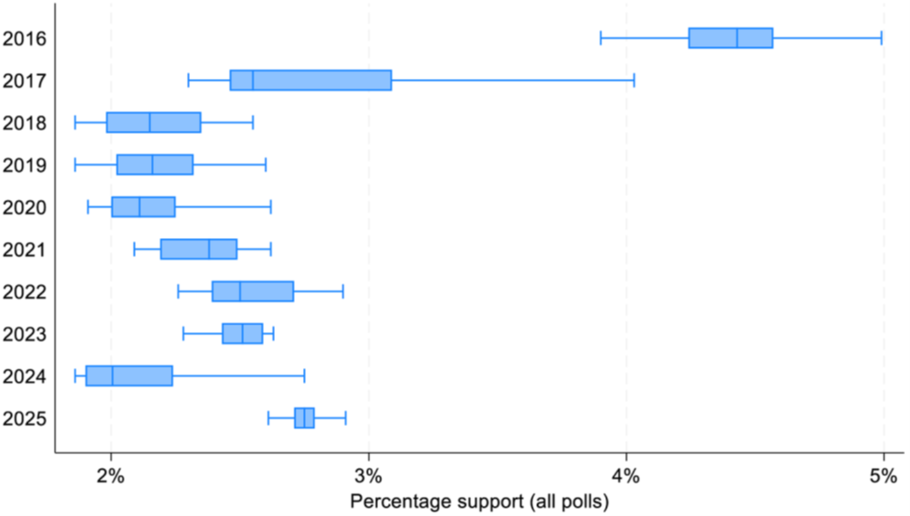
The Irish electoral system does make it easier for outsiders committed to constituency work to win seats. This has contributed to an assumption that PR-STV is sufficient to explain a sustained radical left presence in Dáil Éireann since the Great Recession. But other radical left parties – such as The Workers’ Party, éirígí, and the Communist Party of Ireland – have all tried, and failed, to take advantage of the political opportunities arising from the recession. Also, in the 2024 general election, the far right won 2.6 per cent of the vote, a similar level to PBP-S, but they failed to leverage this support into a Dáil presence. This suggests that the Trotskyist radical left in Ireland must be doing something right that other small and radical political groups are unable to replicate electorally. Importantly, the figures detailed below (see Figures 1 & 2) show that fewer than six per cent of Irish voters self-identify as radical left and the median support for PBP-S in opinion polling tends to be only around 2.5 per cent. So, even with a single transferable vote in multi-member districts, PBP-S faces an uphill challenge to get elected.
I argue that PR-STV is a necessary but insufficient condition to explain the limited – but comparatively significant – electoral presence of the radical left in the Dáil. The electoral system makes electioneering potentially rewarding for small parties, but there are three ‘internal supply-side’ factors that also play an important role in explaining the unusual electoral focus of the Trotskyist left. It is in these three areas of internal party decision-making where the political choices made by radical left activists begin to matter most.
First, their vote-seeking strategy involves intense local activism on issues of working-class concern that are either being ignored or facilitated by more mainstream parties. The strategy is sometimes known as the ‘Dublin West Model’ after the constituency where the Socialist Party, and its then leader, Joe Higgins, first built their base after being expelled from the Labour Party in 1989. The strategy involves a four-stage process: sustained local activism in communities; mobilisation around neglected issues of working-class concern; leveraging this support into local-government representation; and using the resulting councillor base to pursue seats in the Dáil. This electoral strategy has been replicated across all the local areas where PBP-S compete. In the South, issues around austerity, bin and water charges have been important targets for organising. But the strategy is adaptable, and in Northern Ireland, PBP have won representation in the Assembly by focusing on issues specific to the North, such as leisure centre privatisation and Irish language rights.
Of course, using seats in local elections to support national electoral competition is common to most parties in Ireland. What differentiates PBP-S is their focus on neglected issues of working-class concern and the fact that their activism carries on regardless of electoral success. For example, unlike most independent politicians, PBP-S activists regard activism in communities as a natural extension of their ideological commitment to praxis. In fact, electioneering is only viewed as strategically important to the extent that it can support further activism and the development of broader social movements for systemic change. In effect, seeking office is not the main goal of the PBP-S electoral strategy.
Second, inter-left competition contributes to the limited – but sustained – electoral success of PBP-S. This is a two-stage process. Initially, the Socialist Workers’ Network saw the increased profile that the Socialist Party received when they started winning seats in local and national elections. The position of councillor or TD added democratic legitimacy (and authority) to their activism. Importantly, state funding could provide significant resources to further the cause. Not wanting to be overtaken by their competitors on the left, the SWN (then the Socialist Workers’ Party) replicated the ‘Dublin West Model’ in the Dún Laoghaire constituency where they had their strongest activist base. The second stage of this process involved electoral collaboration in which both parties agreed to encourage vote transfers and avoid competing in areas where the other was more electorally competitive. This was done for pragmatic reasons, as the pool of voters open to supporting the radical left is small and splitting the vote would ensure neither side got elected. Patterns of left-wing sectarianism still occur, but the need to collaborate during elections, and within the Dáil for extra speaking time and funding, means that the initial inter-left competition has also resulted in increased cooperation.
Finally, pluralist electoral fronts have been used to reduce ideological rigidity and include the organising talents of people who may not wish to sign up for formal Trotskyist party membership. For instance, People Before Profit comprises two allied networks – the Socialist Workers’ Network and RISE, the latter associated with Paul Murphy TD – as well as left-wing activists who are unaffiliated with either network. Similarly, Solidarity consists of the Socialist Party and unaligned left-wing activists who are not formal party members. This means that activists can campaign alongside these groups without signing up to the whole Trotskyist worldview. In addition, electoral fronts help to detoxify the brand for voters who may agree with many of the policies of PBP-S but would be reluctant to vote for groups that have ‘socialist’ or ‘Trotskyist’ within their name.
These electoral fronts have broadened the appeal and activist base of PBP-S, while allowing the SWN and SP to reserve their own membership for a more ideologically committed vanguard. Importantly, they have also helped to reduce at least some of the excesses of left-wing factionalism. For instance, when the Red Network split from the SWN in 2019, they remained a constituent part of PBP, and a relatively collegial relationship was successfully maintained between the two groups until the Red Network finally left PBP in June 2025. In a development since the research was completed, fifteen activists (including one councillor) resigned from the SWN during the summer of 2026 but remained constituent members of PBP. This ability to retain the organising capability of members within the pluralist electoral vehicles, despite significant internal disagreement, contrasts with the intergroup conflict and bitterness following more typical left-wing splits.
The Irish electoral system matters, but it cannot by itself explain the unusual durability of the Trotskyist left in Ireland. PBP-S has been able to exploit the opportunities provided by PR-STV because of its internal organisational choices concerning local activism, inter-left competition, and pluralist electoral fronts.
This blog post draws on Jonathan’s recently published article in Capital & Class, ‘Hot to Trot: Explaining radical left electoral strategies in Ireland’ (available here).
Figure 1. Percentage of people who self-identify as radical left in Ireland and Western Europe (source: European Social Survey).
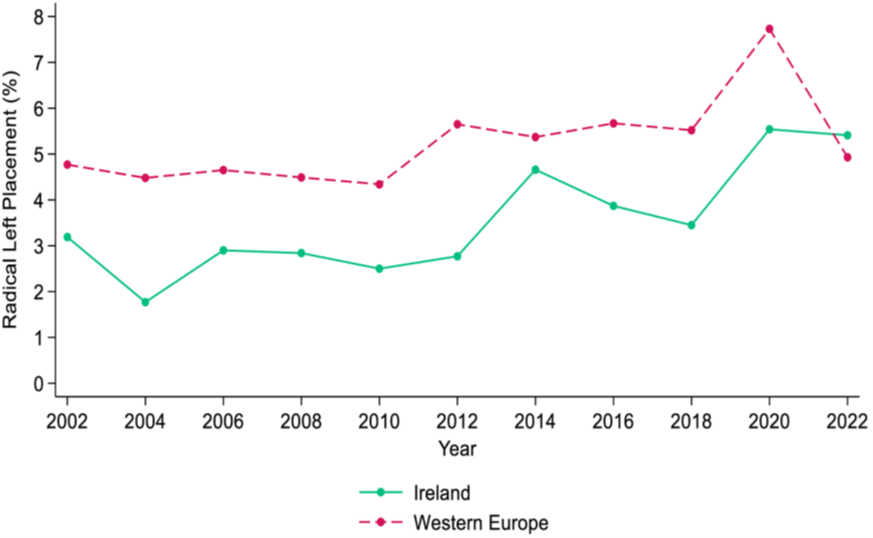
Figure 2. Distribution of People Before Profit-Solidarity polling percentages by year, 2016–2025 (source: Irish Polling Indicator).


Hello Dr. Arlow
I would like to make a quick correction if I may. The Socialist Party have recently abandoned the tactic of having a party front (Solidarity The Left Alternative, Anti-Austerity Alliance) and have rebranded entirely as Solidarity The Socialist Alternative. This is the new party name and the only banner they intend to campaign under, with all candidates being party members.
Thank you.
Kind Regards
Thank you, happy to have that corrected. If I understand correctly, does this mean that the Socialist Party is now only known as Solidarity: The Socialist Alternative?
Kind regards
Jonathan
Yes. The Socialist Party no longer exists.
Could it not be more simply said that the Irish radical left has had a small presence in a diverse parliament by largely refusing to campaign on a radical left platform? At no stage have the radical left parties ever campaigned on the basis of substantive national programme of policies, preferring both blanket criticism of government and charry-picked policies. Is it not relevant that PBP campaigns against the only form of wealth tax Ireland has and which has little to no impact on poorer communities?
I’m not so sure. I think PBP-S have openly advocated for radical systemic change in the Dáil, media, and their manifestos. It is a clear radical left platform that doesn’t accept the dominant economic model. For instance, PBP’s 2024 manifesto called for a ’32 county eco-socialist republic’, substantial wealth redistribution, nationalisation, and mass mobilisation outside parliament.
But I think you have a point about the property tax. There may be a case to exclude pensioners who just have the contributory pension but otherwise it is a relatively progressive tax that is set at very modest levels. It’s far lower than Britain’s council tax and, unlike in the UK, renters don’t pay, at least directly.
Is there not a difference between general advocacy of radical change and actually proposing radical change? In order to see their success as success of the radical left is there not some more direct link required to establish what people are voting for?
In their 2024 manifesto they again say that everything can be achieved without it impacting on anyone who earns less than 100k per year. In fact they proposed tax cuts for 86% of the public. The ‘eco-socialist’ vision includes the abolition of carbon tax because everything can be achieved by taxing companies and individual behaviour is irrelevant to reducing carbon emissions.
It is possible to argue that all of the radical left seats are based on local ‘ward-healing’ activity rather than the success of a radical ideology. Therein might be found the source of their success but also their failure to grow further in spite of the radical de-alignment of Irish politics in the last 15 years.