Dr Valesca Lima is an Assistant Professor of Politics at Dublin City University’s School of Law and Government.
The PSAI and PSA Participatory and Deliberative Democracy Specialist Groups held a one-day conference on August 9th, 2024 entitled “Cross-border Transformations: Deliberation and Participation in Constitutional Politics”. Hosted at the Geary Institute at University College Dublin, the event brought together leading scholars, practitioners, civil servants and members of the public to explore questions and debates about the use of participatory and deliberative democratic innovations to address questions of constitutional reform and territorial politics.
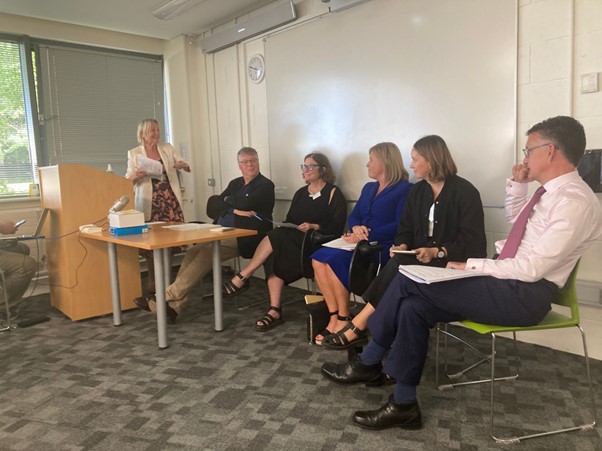
The conference opened with remarks from Dr Valesca Lima, co-convenor of the PSAI Participatory and Deliberative Democracy Specialist Group, setting the stage for a day of in-depth discussions on the role of deliberative democracy in shaping constitutional futures. The event featured three panels, each delving into different aspects of deliberation and participation in the context of constitutional change.
The first panel, titled Deliberative Democracy in Action: Reintegration, Constitutional Futures, and Bridging Societal Divides, offered a broad exploration of how deliberative practices are being employed to address critical issues in the UK and Europe. Presentations covered topics such as deliberation on constitutional futures in Wales, the use of digital forums in policymaking, and the design of mini-publics for divided societies. The panel also examined innovative approaches to UK-EU relations post-Brexit through deliberative scenario models. Chaired by Dr. Valesca Lima (Dublin City University) and with Dr. Shelley Deane (Dublin City University) as the discussant, the panel highlighted the potential of deliberative democracy to navigate complex and contested political landscapes.
Following a networking lunch, the second panel, Can Participation Rebuild Trust in Divided Societies? Exploring the Potential of Deliberation to Rebuild Trust, took a closer look at the power of participatory processes in restoring trust in deeply divided contexts. Case studies from Lebanon, Ireland, and Northern Ireland provided valuable insights into how deliberative democracy can move societies from pluralism to more cohesive governance. Discussions also centred on the role of political participation in initiatives like the Dublin-Belfast Economic Corridor and new approaches to engaging Northern Ireland’s unionist community in conversations about constitutional futures. This session was chaired by Professor Jane Suiter (Dublin City University) and Dr. Anthony Costello (Liverpool Hope University) was the discussant.
The final panel, Deliberating on the Irish Constitutional Future from the Grass Roots and Tree Tops, brought together experts and stakeholders to discuss the future of Ireland’s constitutional landscape. The session, held in association with ARINS (Analysing and Researching Ireland North and South), featured contributions from Professor Jane Suiter (Dublin City University), a co-recipient of the Brown Medal on Democracy and research lead of Ireland’s Constitutional Convention and Citizen’s Assembly who has written extensively on deliberation. She argued for the need for multiple interconnected fora for deliberation on the island. Rose Conway Walsh (Sinn Féin Spokesperson on Public Expenditure and Reform) spoke about the work of the Oireachtas Committee for the implementation of the Good Friday Agreement, where she leads on the Report on ‘Constitutional Change’, in preparation for a referendum, and about Sinn Féin policy. Rory Montgomery, who was a negotiator in the multi-party talks that led to the Good Friday Agreement and is Brexit lead in Ireland’s Department of Foreign Affairs, expressed a degree of scepticism about the deliberation process on potential constitutional change. Rebekah McCabe leads on Involve’s work on Northern Ireland. She developed the first Citizens Assembly in Northern Ireland in 2018, on older people and social care, and she chairs the Northern Ireland Open Government Network. She spoke of the difficulties of constitutional deliberation in Northern Ireland and the North-South knowledge gap. Mark Hennessy, Ireland and Britain Editor of The Irish Times, created and edits the newspaper’s Common Ground series. He spoke of his experience as a Southerner in Northern Ireland, and of Southern attitudes to Northern Ireland. Chaired by Professor Jennifer Todd (University College Dublin), this panel provided a rich dialogue on the grassroots and elite perspectives on Ireland’s constitutional future. A recording of the panel can be accessed here.
This conference was a significant milestone in advancing the conversation on how deliberation and participation can help navigate the complexities of constitutional change, which will contribute to ongoing debates and initiatives across borders.
 Irish Politics Forum